
One Day in Copenhagen Itinerary: What We Did and How You Can Do It Better
August 28, 2025
After Becoming a Mother: The Harmful Lie We Tell Ourselves About Brain Fog
January 9, 2026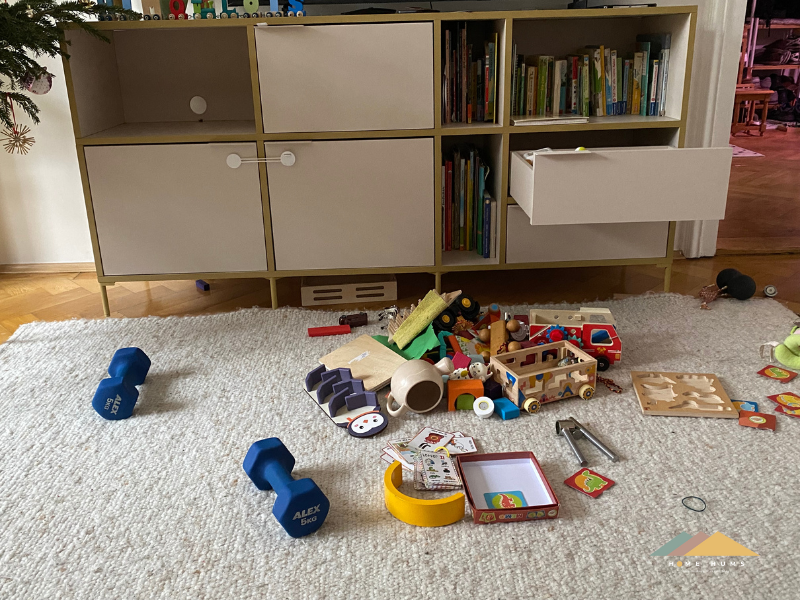
Before we leave the house for our pre-nap walk, I do one small thing almost on autopilot. I box up my child’s toys. And encourage him to help.
Not all of them. Just enough so that when we come back, we are not greeted by chaos. I know this might come off as overdoing it, in the “too much” box that I often get anyway. But it’s my way of telling my nervous system that we will come home to something calm, something that does not ask too much of me.
I learned this habit consciously.. As a new mother. As an immigrant. As someone who gets overstimulated and overwhelmed by a messy space. As someone who knows that the space you return to matters more than the space you leave behind.
The holidays disrupt that rhythm.
It is January 4th now. Yesterday, his godfather came to visit and brought toys. Lots of them. A week before that, we gave him a gift: a secondhand Woom—a push bike that still cost us €150 even though it was a secondhand purchase. His grandparents gave him gifts: one is a new set of wooden building blocks, second is a wooden toy car that the LO’s father owned when he was a child (I like this kind of gift.). His other godfather gave him a gift. In the span of days, his toys doubled. The boxes I usually rely on are suddenly not enough.
And that is when the question crept in, quietly but persistently: is this actually necessary?
Don’t get me wrong: this is not a question about gratitude. I am grateful. Deeply so. My child is loved. He is thought of. He is surrounded by people who want to give him joy. I carry that knowledge with me, especially as someone raising a child far from where she grew up. Especially as someone who never grew up and felt seen, celebrated, and loved this way.
But gratitude does not cancel discernment. Love does not necessarily require accumulation.
Some of the toys are nice. Thoughtful even. Some are not for his age yet. Some are duplicates of things he already has. Say, he received a set of Montesorri velcro fruits, sandwiches, eggs with a small wooden knife. He already has three knives (plastic knives). Three. He uses them to help us cook. He cuts actual fruits and vegetables in the kitchen, carefully, proudly, with full concentration and confidence. He cracks his own breakfast eggs. And currently, he is exploring the wonders of a grater.
When he helps cook, he is not pretending. He is participating.
So what exactly is the toy replacing?
This is where my perspective as an easily overstimulated immigrant Filipino mom living in Germany complicates the holidays. I grew up with celebrations that were loud, communal, improvised. Gifts were not the center. Food was. Presence was. You showed up with what you had, not with what matched an age recommendation on a box. I’m aware this doesn’t hold true anymore with the culture my nephews and nieces grew up/.
In Germany, holidays that the little one is exposed to feel quieter but heavier with intention. Thought-through. Planned. (Who is preparing the appetizer, the main, the dessert?) Somewhat gift-oriented. There is a structure and ritual to it that I respect and actually enjoy. But it seems like Christmas (and most likely his birthdays) is a beast I have to reckon with. Its aftermath overwhelms me now that I am responsible for another human being’s environment.
Because toys are not neutral objects. They take up space. Physical space, yes, but also mental space. They ask to be sorted, rotated, cleaned, stored. They break. They get lost. They outgrow their purpose at a pace that does not match the effort it takes to manage them.
Children upgrade and move on faster than their attention spans.
A toy that is exciting today is irrelevant in three weeks. Not because the child is ungrateful or bored, but because development is relentless. What once challenged them becomes obvious. What once felt new becomes background noise.
As a mother—I’m the chronic sorter and organiser in the household; and most likely this is the painful and sad reality in most households—especially a new one, you are left holding the aftermath of good intentions.
And so I find myself thinking ahead. To the next holidays. To the next wave of generosity. And I know that next time, I will say it clearly: toys are a no-go.
Not because I want less love for my child. But because I want more alignment.
There are other ways to give.
Ways that actually support a child instead of adding to the household’s invisible labor. Ways that respect where he is right now, not where a packaging label says he should be.
A voucher from DM for diapers. For skincare that works for his dry skin in winter. For the practical things that get used fully, without guilt or clutter.
A bundle of used clothes from Vinted. Clothes that already lived a life, that do not need to be precious, that can be stained and outgrown without ceremony. Honestly, I would take that over another toy any day. A Vinted voucher, if that exists. And if it does not, maybe it should.
Even money. Straightforward. Honest. Money that can go into an account that is his. Money that acknowledges that a child’s future is built quietly, not all at once, not always in wrapping paper. €5. €10. Whatever the planned budget for the gift.
Maybe it is time he has his own bank account. Not because he needs savings at this age, but because it sets a different narrative. One where giving is not about immediacy, but about continuity.
And yes, experiences. Always experiences. A zoo visit. A swimming session. A train ride somewhere small and nearby. Things that end without needing a shelf.
Holidays, as a new mom, strip you of the illusion that you can control everything. You cannot manage every object that enters your home. You cannot curate every influence. You cannot protect your child from excess just by being intentional.
But you can set boundaries around your capacity.
That is the real lesson I learned here. Not toys versus no toys. But what kind of load you are willing to carry in the name of tradition, politeness, or expectations that were never designed with immigrant mothers in mind.
Because living far from home means you already hold a lot.
You translate cultures daily. You explain traditions. You absorb comments. You manage logistics without a village that looks like the one you grew up with. Every object that enters your space lands on top of that context.
So when I box up toys before leaving the house, it is not about order. It is about care. Care for the version of me that will walk back in, tired, holding a sleeping child, needing the room to meet me gently before opening the laptop and work as much as possible before the little one wakes up.
I am learning that holidays do not have to be loud to be meaningful. They do not have to be full to be generous. Sometimes the most loving thing is restraint.
Next time, I will say it in advance. And align it with the husband. Kindly, but clearly. No toys. Here are the alternatives. Here is what actually helps us. Here is what fits the child you are trying to honor.
And if someone still brings a toy? That is okay too. I will box it up. Rotate it. Pass it on. Let it live its life without letting it take over ours.
Motherhood has taught me many things. One of them is that harmony is not accidental. It is maintained. Intentionally so. Quietly. Repeatedly. Often invisibly.